
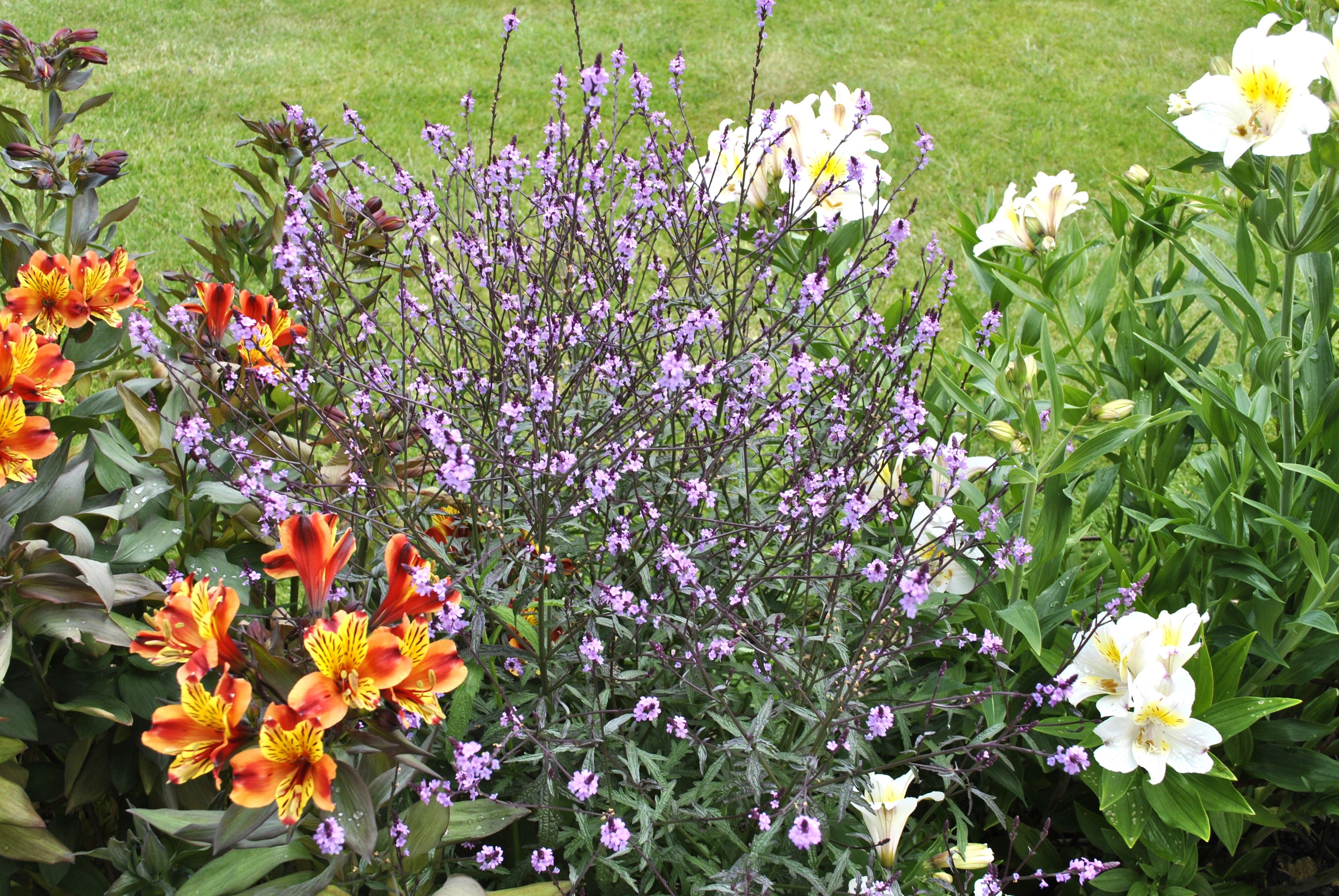
It’s raining again! I have a list of jobs to do in the garden, some of them quite urgent and involving power tools, which will have to wait. However, I did manage to pop out between the showers to photograph six things for this morning’s post. First up is Verbena ‘Bampton’ which popped up all by itself between two Alstroemerias. So, does this make it a weed? A plant in the wrong place? It certainly seeds itself about in my garden and I am constantly pulling up seedlings alongside those ‘true’ weeds like Bittercress and Sun Spurge. I allowed this one to grow to maturity as I thought the colour combo might work. The wiry mauve flower spikes certainly make an interesting contrast.

My unusual hanging basket by the front door has certainly prompted a few comments this year! However, it is certainly eye-catching and colourful, if you like yellow and green, and soon it will be covered in tiny bright red fruits of Tomato ‘Tumbling Tom Red’. Which?Gardening magazine want to know whether it grows well in a basket or pot and whether we get a good crop of tasty tomatoes. It all looks promising at the moment but it certainly takes some watering and feeding to keep it going.

The little Japanese aster, Kalimeris incisa ‘Charlotte’ is just starting to flower and, although a little swamped by the surrounding plants, it is holding its own at the moment. A clump-forming perennial to about 60cm tall producing a mound of dark green foliage topped with pale purple daisies with gold centres, produced over a long period from mid-summer to mid-autumn. I have a few Chrysanths too but these Kalimeris flower earlier and for longer, don’t succumb to mildew and, so far, are not eaten by slugs and snails.

Every year, visitors to my garden ask what this is. I am amazed it is not grown in more gardens and sold by more nurseries and garden centres, for it is a superb easy-to-grow plant. Diascia personata is a semi-evergreen perennial with upright stems producing racemes of small pink flowers with darker pink centres from late spring into autumn. I have had it for several years and take cuttings in late summer in case of winter losses. It needs a bit of support so it grows happily in amongst other plants. I grow it with Hesperis matronalis which is over by the time the Diascia flowers.
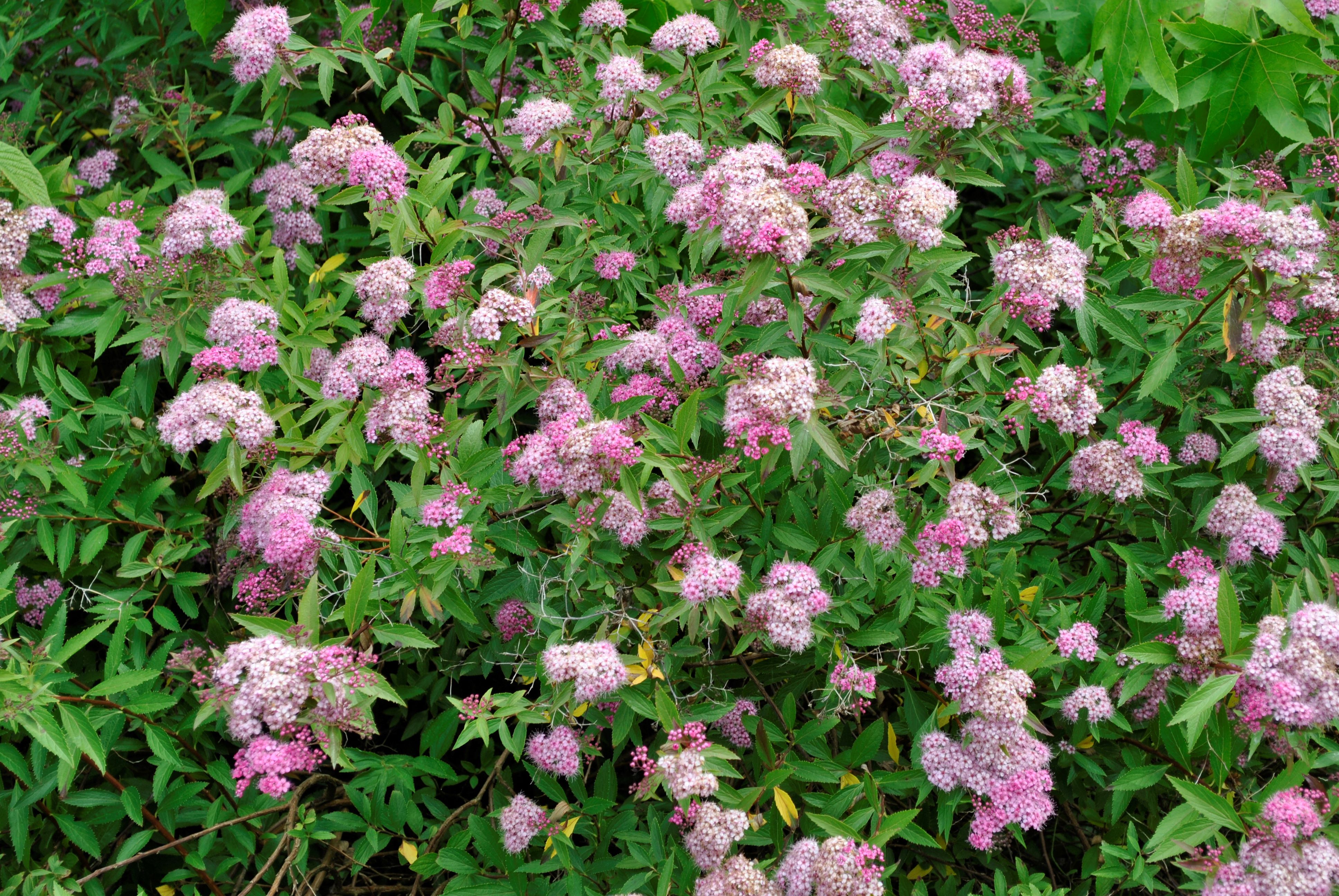
Possibly the oldest shrub in the garden is this Spiraea japonica which was grown from a cutting 16 years ago when we moved here. A neighbour was digging it out and disposing of it as he thought it was ‘ugly’, and decided to replace it with a Cornus kousa which is now a thing of great beauty in every season. Ugly or not, it is an undemanding shrub which flowers briefly in early summer, gets pruned hard in winter and is forgotten about until the following July.

Salvia forskaohlei or Indigo Woodland Sage, has huge leaves and enormous spikes of indigo flowers, very different from the usual shrubby or nemerosa types. In fact, Salvia is the largest genus of plants in the sage family Lamiaceae, with nearly 1000 species of shrubs, herbaceous perennials, and annuals. This one is totally hardy and great for poor, dry soils where it will spread and cover the ground in no time. In my garden it is in the ‘difficult’ border where little else thrives in the almost impenetrable clay. It is a magnet for bees and other pollinators too.


Finally, I am looking for some help identifying this pretty cluster-flowered floribunda rose which is rambling over my archway. It was inherited with the garden and is reliable, very healthy and flowers for several weeks in July and August. A friend has suggested it might be ‘Dorothy Perkins’. Has anyone got a similar or alternative suggestion please? I would love to know its name.
Have a great weekend
David
 Davids Garden Diary
Spirea japonica-I have three clumps of it in the front because the former owner of the house planted them and it is a north facing spot that I just don’t bother with. One of the groundskeepers at the University told me it is proof that there is a pant for every purpose. She said that one is for gas stations and parking lots, because one absolutely doesn’t need to do anything to it. I agree, except I like mine to stay small, so I cut it to the ground in winter. The tomato basket looks interesting!
Yes, car parks and other areas where you can plant it and forget it! Over here the maintenance guys zip over it with a power trimmer and it always comes back better than ever!
The tomatoes are just starting to form so it should make a good photo in a couple of weeks.
Yup, in fact, I think it looks best if I cut it nearly to ground in late winter. It grows nicely in a spherical shape, blooms well and I have never once watered it or fertilized it. It had terrible aphids last year, but the ladybugs and friends came by and feasted. So, what would I do with this north facing spot where the previous owners put down landscape cloth and rocks. Weeds poke through and get pulled. The ostrich fern that I tstuck next to the stairs is spreading. Hmm, if I pulled the spirea and let the ferns take over…but they would likely start coming up in the lawn.
It might be weedy in your garden but I think Verbena ‘Bampton’ is lovely. Diascia personata got killed by frost a few years ago in my garden although I believe it is the hardiest diascia and what a show it makes. I agree, the rose looks like ‘Dorothy Perkins’ to me too.
Hi Chloris. I agree that V. ‘Bampton’ is a good plant but, like so many other prolific self-seeders, they can become a weed if not managed ruthlessly. I have the same problem with Hesperis, Verbena bonariensis, Lychnis coronaria, Nigella and Scabious. If I let all their progeny survive, I would have millions and they would take over the garden!
The Diascia is on the tender side so I always keep a few rooted cuttings in the cold greenhouse over winter just in case. They are so easy to root provided you can find a non-flowering side shoot!
Thanks for the Dorothy Perkins vote. It is certainly a pretty rose and one I am going to propagate from cuttings over winter.
I discovered Kalimeris a few years ago. It thrives in a container on the east facing deck. I love its upright habit and delicate blooms. So I started a new container from cuttings this spring.
Hi topdock. At one time, Kalimeris was a strong contender for a National Collection as they are such good plants and not many species and cultivars. However, I was seduced by Tradescantia instead! I will slowly build up my stock of Kalimeris though, just in case I change my mind!
Spiderwort (Tradescantia virginiana) is a native in my area. Zone 8 Central Alabama. The other that is hardy in this area is T. Pallid. “Purple Heart”. It dies back but spreads beautifully once the warm weather awakens it.
It looks like you’re going to get lots of tomatoes, I hope the bracket is very strong! Whatever the rose turns out to be, it’s beautiful.
Thank you Helen. Yes, the tomatoes look as if they will produce hundreds of fruits from just two plants and that will add a lot of weight! The bracket is bolted into the wall so it should be strong enough to hold it up, fingers crossed! I have had one more vote for Dorothy Perkins for the rose name so I think I was on the right lines.