Six on Saturday

Back in the day, my Mum & Dad raved about Rosa ‘Blue Moon’ and so when I heard about Rosa ‘Twice in a Blue Moon’ I thought it must be pretty special. What a let down! Pale, floppy, untidy and uninteresting muddy purple flowers following a perfect pink rose bud. Just goes to show, don’t believe the hype!

The Rudbeckia fulgida ‘Goldsturm’ are providing some much needed interest and colour in the herbaceous border and cover the greenery of earlier plants which have finished for the year. Lovely pops of yellow dazzle and crave attention.

I just love bright red Geraniums (actually Pelargoniums but everyone calls them Geraniums!) these beauties were 79p each in modules of six from the forecourt at Lidl and such great value for months of colour. They are forgiving if you forget to water them for a week, need hardly any feeding and keep flowering until the frosts cut them down in November. They add a touch of glamour to the steps too!

The Silphium perfoliatum, or Cup Plant, is a tall perennial daisy from the prairies of North America and a reliable hardy addition to the shrubbery where it provides height and late colour. I grew it from seed several years ago and it now self-seeds freely which provides me with spare plants to offer in plant sales and to exchange for things I want. Very attractive to bees, bulletproof and a great alternative or addition to perennial sunflowers, Rudbeckia and other yellow daisies…..if you like yellow daisies….which I do!

I wonder if anyone can help me identify this plant please? I have a suspicion it might be a variegated form of Ophiopogon but it could equally be a Carex, Liriope or similar grassy plant. A kind friend gave it to me without a label, because she didn’t know what it was either! It is short, 30cm, hasn’t flowered (yet) and seems to spread by underground runners (like Ophiopogon). I look forward to suggestions please!

Finally for this week, Astrantia major which is having a second flush of ‘Hattie’s Pincushion’ flowers, probably thanks to the warm and wet July and August. It is usually over for the season by now, just another oddity in an odd year for the garden.

Have a great weekend

David

Six on Saturday

One of the beautiful Tradescantias from my ever increasing collection which, fingers crossed, will become accredited as a National Plant Collection by the Plant Heritage Conservation Committee on Monday 6th September. Currently 39 hybrids and cultivars, two species and 7 identified and awaiting collection from Nurseries around the country.

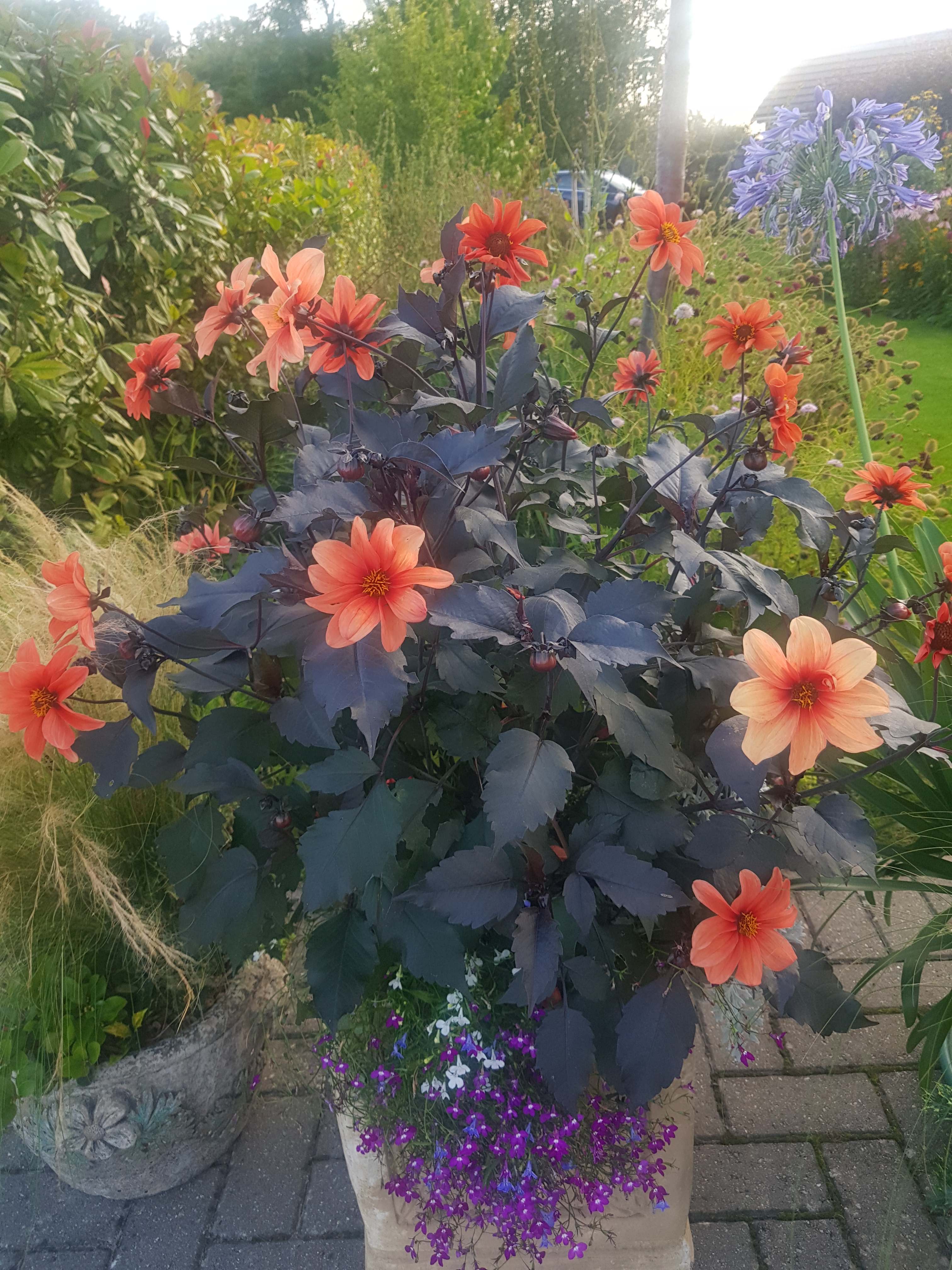
This Bishop’s Children dahlia, grown from seed this year, has been getting quite a lot of attention on social media, due mainly to the colour combination I think. The peachy apricot flowers go really well against the dark foliage. Unfortunately, the blackfly have been a real problem this year and even if squished or washed off, they seem to keep coming back for more! I don’t spray with chemicals in case I also kill off natural predators like Ladybirds, lacewing larvae and blue tits.

So, here we are at the end of August and still no flowers on the Cannas! They are trying really hard but they need warmth and sunshine. Hopefully they will get both this coming week as the weather forecast is for a return of summer for a few weeks.

It’s not glamourous or even particularly attractive, but the spikey leaved Echinops ritro is a real survivor and is one of the best bee plants you can have in any garden. It thrives in poor thin alkaline soils in full sun which is why it loves my dry stony border. It is almost impossible to eradicate and spreads by underground runners which is why it is so easy to propagate from root cuttings.

Rudbeckia fulgida ‘Goldsturm’, the most common form of perennial rudbeckia showing why she is so popular in gardens at the moment. Bone hardy, totally reliable and yellow with a black eye, hence the common name Black Eyed Susan. Mixed with purple monarda and orange heleniums, it revels in a sunny border unfussed by soil type and moisture. Almost the perfect border plant..

I have a bit of a love hate relationship with Scabious because it is beautiful and a useful bee plant but is becoming invasive due to it’s annoying habit of self seeding everywhere. This Scabiosa atropurpurea ‘Derry’s Black’ is now officially a weed in my garden and needs a firm hand otherwise it swamps it’s neighbours. It gradually finds its way into all parts of the garden and must be removed swiftly and without compassion, something I am not good at.

Well there we are, six things on a rainy Saturday in August!

Have a great weekend

David